About Me

My Photo
Keith Gault
Hello! My name is Keith Gault and I've been tramping the hills of the UK and further afield for over 30 years now. This blog records some recent hill days undertaken either on my own, or with clients under my guided hillwalking Company: Hillways (www.hillways.co.uk). I hope you enjoy my diary; please feel free to comment on any of the walks. I will respond to any direct questions.

View my complete profile

Saturday, 14 November 2009

The Arrochar Alps - I: Beinn Narnain & Beinn Ime

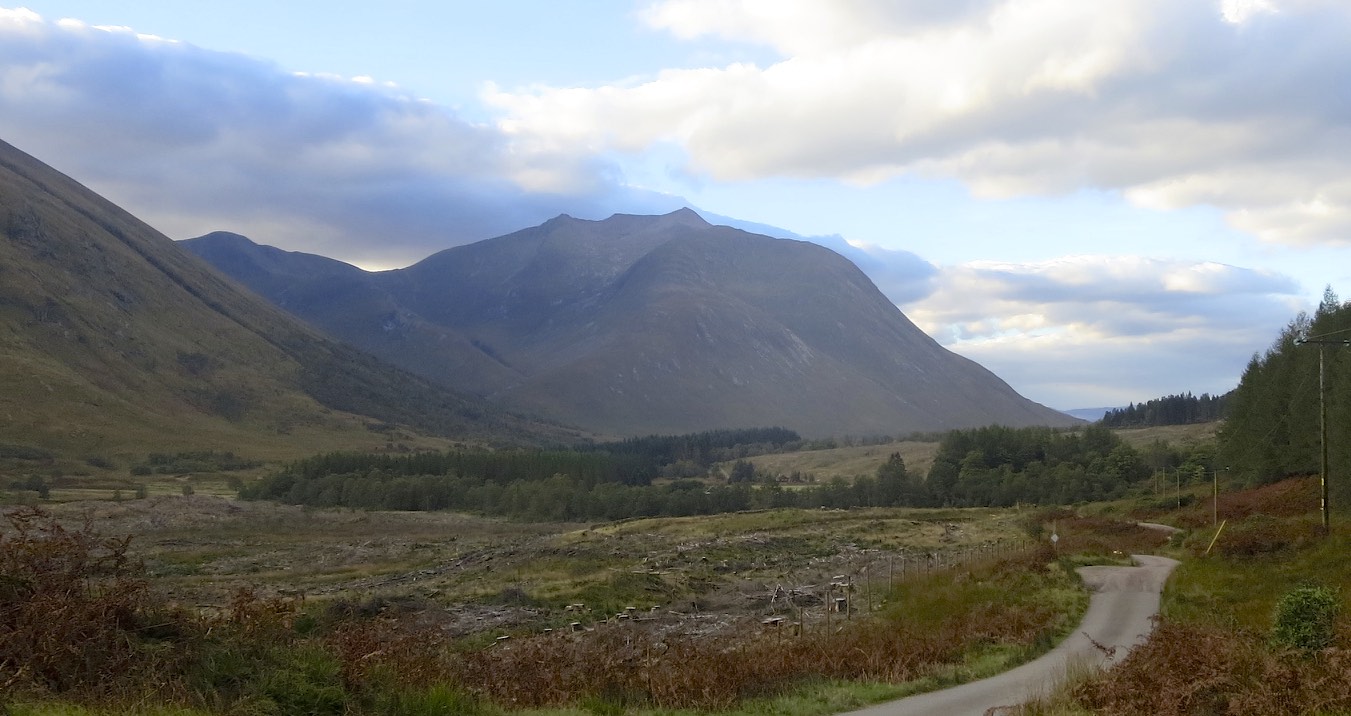
The Arrochar Alps From Loch Arklet

Half way up the western side of Loch Lomond lie a small clutch of rugged hills collectively known as the Arrochar Alps. Four of these peaks attain Munro status through nothing but their height as some of the lower mountains in the area are equal to - and in one case (The Cobbler), significantly exceed - their vaunted cousins in grandeur and character. The 4 Munros can be tackled individually or as two pairs. On a grey, wet and windy November day we elected to try the easier two: Beinn Narnain & Beinn Ime. These plain speaking mountains are connected by a spitefully low bealach at 637m which ensures the ascent of them both is not attained without grim determination!

Beinn Narnain

The best start (albeit from sea level) climbs directly from a point 70 yds along a new Forestry path opposite the large (Pay & Display) car park at the head of Loch Long at Arrochar. A wet and rocky path leads straight up the hillside beside a line of old concrete blocks associated with hydro-electricity construction work. Close to the 300m level, an even wetter track crosses the path at 90 degrees. Continue straight on and up, over and around a series of outcrops and mounds until the intermediate top of Cruach nam Miseag (813m) is reached. This normally gives some welcome respite from the climb but on this occasion such thoughts were tempered by a strong and cold wind which suggested no stopping. A short time later, the rocky prow of the Spearhead appeared out of the murk and a scramble up a narrow rocky gulley on its right gave us the summit of Beinn Narnain (926m; hill of the notches) where a stone trig point heralds the end of the climb. Needles to say, this was no place for lunch, resting or personal introspection on this wild November day so we quickly descended to the aforementioned wickedly low bealach to begin our remorseless trudge up the sodden southern slopes of Beinn Ime.

Beinn Ime

Today, the only visual relief afforded us on this near-400m slog was a short flurry of snow which gave us something to smile about as darkness beckoned. Eventually, assorted soggy peat, moss and grass gave way to rock and we finally stood on the summit of Beinn Ime (1011m; hill of butter), the highest point in the Arrochar Alps.

The descent retraces the outward route to the bealach before slipping between Beinn Narnain and the Cobbler and descending south-eastwards past the conspicuous Narnain Boulders and alongside the delightfully named Buttermilk Burn. In the dark, the twinkling lights of Arrochar welcomed us back to sea level and the inviting embrace of a warm car, the lunch I had carried with me all day, and at long last, a place on the planet where the rain could not reach!

Check out my future plans for the coming winter on: http://www.hillways.co.uk/winter/winter.htm


Saturday, 7 November 2009

Schiehallion

Schiehallion

Four ascents of this famous Scottish peak have yet to produce a summit view! I shall keep perservering though as its central, but isolated location and excellent path make it a handy peak for a short winter's day. It is also one of Scotland's shapliest peaks, its distinctive cone making an impressive sight, particularly from the north west. Look out for a distant view whilst driving south across Rannoch Moor.

Much of the mountain is now owned by the rightly lauded John Muir Trust which own and maintain an increasing number of Highland mountains to the lasting benefit of hillwalkers. A sizeable car park has been constructed just east of the Braes of Foss farmhouse above Tummel Bridge and a new path now intercepts the mountain's east ridge before continuing over quartzite boulders to a near cairnless summit! From here wide views open out in all directions. Allegedly! Schiehallion (1083m; fairy hill of the Caledonians) is close to the geographic heart of Scotland and was once used in exepriments by the Astronomer Royal to help determine the earth's mass by measuring the deflection of a pendulum caused by the mountain's own mass. It also has one of the most attractive names of any Scottish mountain, when translated into English.

First Frost of Winter on Schiehallion's East Ridge

It would be a good mountain for New Year's Day!

Check out my future plans for the coming winter on: http://www.hillways.co.uk/winter/winter.htm

Saturday, 24 October 2009

Assynt & Coigach - The NW Highlands

Stac Pollaidh

‘Gloves’ Douglas was in town and was looking for some action. He had Weegie Girl tagging along with him. If there were hills to be climbed, she wanted in! So I found some hills for them and off we went to the far north-west of Scotland, to the ancient lands of Assynt and Coigach. The hills here are perfect two-thirds replicas of the mighty Torridon mountains further south and offer great hillwalking for less effort than your typical Munro. ‘Gloves’ arrived with his truckload of Red Bull determined to get up as many hills as possible and Weegie’s new boots looked like she meant business! Mind you, she normally does! Mighty Mouse also came along for a few days to help with wine consumption and menu selection from the world-famous Lochinver pie shop!

Ben More Coigach

Day One called for an easy walk-in, good views and not too much distance – Ben More Coigach fitted the bill admirably. This complex hill presents a solid wall of Torridonian sandstone to those driving north up the Ullapool road. In reality, this wall is but one side of a reclining horseshoe and the mountain actually comprises several distinctive tops, foremost of which is Sgurr an Fhidhleir (705m; peak of the fiddler) which sticks out a blunt uncompromising nose across the loch-strewn landscape to the north. We parked at Blughasary and walked up a good track for 3 km before cutting across country to climb Ben More Coigach’s eastern top, Speicein Coinnich (717m). This entailed an interesting but successful river crossing which everyone achieved without mishap! Once on top the long ridge stretched out towards the sea and the Summer Isles glistened in the autumnal sunshine. The actual summit of Ben More Coigach (743m; big hill of Coigach) lies just north of the main ridge. The going is very easy and the traverse of the main ridge is full of interest. As you work your way down to the south-western top of Garbh Choireachan (733m), the ridge becomes a narrow scramble over sandstone pinnacles all of which can be by-passed on a good path on the northern side.

Approaching Garbh Choireachan

We returned the same way enjoying great views all-round, but particularly to the north where all of the following week’s hills could be seen stretching away towards the top of Scotland. This was Gloves’ first outing with trekking poles and it was only late in the day that we became aware of how like Brad Pitt they made him look. Brad Pitt playing Benjamin Button that is! Once he was shown how to extend them beyond the 3 feet length he had seemed happy with, all was well and he was able to walk quite upright! That said, his slow motion back-flip into a peat bog was executed with great aplomb! Some people are just so ostentatious and attention-seeking on the hill don’t you think?

Stac Pollaidh's Crumbling Summit Crest

The next day saw us tackling Scotland’s finest wee hill – Stac Pollaidh (612m; steep rock at the pool). This diminutive, but spectacularly attractive prominence is a crumbling ridge of sandstone surrounded by steep heather-covered scree slopes that give it a somewhat volcanic – and extremely photogenic - appearance from the east. Stac Pollaidh stands only a kilometre north of the twisting single-track road to Achiltibuie above Loch Lurgainn. An excellent path climbs and curves around the eastern side of the mountain and on to a saddle on the summit crest. Once on top, it’s just (did I say just?) a scramble along the ridge over, along and around a series of sandstone pinnacles until a final ‘difficult step’ suddenly throws down a challenge to those uncomfortable with slipping, falling and death! The small tower that now blocks the way looks worse than it is but caution is definitely advised even though the actual summit of the mountain now lies only a few metres beyond. Today, a ferocious wind persuaded us that retreat was the better part of discretion and we retired back along the ridge in no way feeling short-changed such was the entertainment value (and challenge) of the rest of the ridge.

'Gloves' Ponders the Difficult Step With A Secret Admirer!

Rather than return by the upward path, we picked up a continuation of the path that circles the whole hill thus allowing close scrutiny of the entire summit ridge from below. Stac Pollaidh offers a short day and is an ideal ‘stocking filler’ in between the bigger mountains in the area. It is always interesting and never palls no matter how many times you scramble along that crumbling pile of sandstone. Be quick though; devoid of its protective quartzite cap, the mountain’s sandstone is eroding rapidly and the elements are busy remodelling the pinnacles - they wont be there for ever!

Cul Mor

Our third hill day took us to the highest peak in Coigach, Cul Mor (849m; big back). From a lay-by below Knockan Crag 3km south of Elphin, a good stalkers path leads across country before climbing gradually up gently sloping quartzite strata to the subsidiary top of Meallan Diomhain. Here, the underlying rock changes to the familiar Torridonian sandstone and the summit cone of Cul Mor rises up directly in front of you. This can be tackled head on up steep mixed ground or, more usually, by crossing a small plateau and ascending Cul Mor’s north-eastern ridge. This provides not only a welcome path, but also good views across to Suilven – the pride of Assynt – and the impressive Coire Gorm (blue corrie) whose cavernous recesses drop vertically from the summit of the mountain. Take care approaching the summit as you once again encounter the quartzite in the form of tricky-sized boulders which demand care, particularly when wet. Once on top, however, no further difficulties should be encountered.

A Weak Attempt at Hiding on the Summit of Cul Mor!

When climbing Cul Mor, do make the effort to walk the near-level kilometre along the mountain’s north-western ridge, Sron Garbh (rough nose), to a spectacular viewpoint over the Inverpolly National Nature Reserve. This vast empty area of ‘lochan and knockan’ landscape sits on underlying Lewisian Gneiss, some of the oldest rocks in the world at 1500-2500 million years of age, which surprisingly predates even the X-Factor! Those envisaging an exploration of this remote and watery land would be well advised to consider asking Santa to bring them a canoe for Christmas! The return to the car reverses your route back along Sron Garbh to a gravelly bealach between Cul Mor and its twin top Creag nan Calman (828m; crag of the dove). This can be climbed for completeness before descending eastwards back over Meallan Diomhain to the stalkers path.

Quinag on a Sunnier Day

Day 4 took us to the northern edge of Assynt and the wonderful 3-Corbett triptych that make up Quinag (milk pail). The complex Y-shaped collection of peaks and ridges looks particularly impressive when approaching from the north over the graceful curve of the Kylesku Bridge. However, the mountain is most accessible from an old quarry car park just below the summit of the watershed between Loch Assynt and Kylesku. This gives a relatively high start and a good stalkers path (currently undergoing well needed repairs) to follow initially before cutting across to pick up the easier slopes of the mountain’s southernmost peak and first Corbett, Spidean Coinich (764m; peak of the moss). This entertaining climb ascends over gently sloping strata of quartzite before dipping slightly followed by a final steep climb up to the summit. Today, this became a real battle against a remorseless buffeting wind and it was a real struggle to fight our way to the summit cairn which is perched right on the edge of the peak’s northern face. We were getting quite angry with the wind now so wasted no time in moving on in search of some shelter. As expected, once below the summit cone we entered a zone of calm which enabled us to stand upright and engage in conversation again, let alone walk properly! Regrettably, the thick cloud precluded our full enjoyment of the usually entertaining central spine of Quinag and we didn’t see anything until well down the mountain. A comfort break whilst ‘Gloves’ went off in search of a fully-flushing WC (or so it seemed given the time he took) ensured Weegie and I cold-soaked for just a bit too long. The resultant warm-up exercises in the form of a stylish hip-swerving dance thing (with impressive use of trekking poles for visual effect) was gleefully captured on video by ‘Gloves’. He will publish it on Facebook at his own peril.....!

!
video
Not For General Release!
The continuing dreich failed to convince us that the complete traverse of Quinag’s ridges and 2 other Corbetts would be worth the misery so we turned off at the Bealach a’Chornaidh and followed the stalkers’ path back to the car. Quinag is a great mini-massif, full of entertainment and interest. It is worth keeping for a good day, or at least a day of clear tops so the intricacies of the mountain can be enjoyed and appreciated to the full. It also comes complete with a fully-flushing loo – allegedly!

Brocken Spectre

For our last day, we decided to climb Cul Beag (769m; little back). This hill provides a good half-day with a short walk-in and modest climb whilst giving great views over the Coigach peaks. A larger than usual passing place 3km along the Achiltibuie road from Drumrunie provides a useful start for a fairly damp pathless trudge up a soggy corrie to the 500m level. Here, the going gets easier over a sandstone pavement until the upper mountain appears and a steep climb takes you up the final slopes to the summit. Swirling cloud and bright sunshine conspired to give us a great view of our brocken spectres – rainbow-coloured halos which encircle your own shadow and which are a familiar sight in such conditions. ‘Gloves’ was much impressed!

This was a great week with great companions who were a real pleasure to walk with. Check out my future plans for similar walks on: http://www.hillways.co.uk/summer/summer.htm

Saturday, 26 September 2009

The Pyrenees


Professor Higgins may have known a thing or two about phonetics but his understanding of Spanish meteorology was clearly flawed: the rain in Spain does not fall mainly on the plain. Neither does the snow! Our 5-day trek through the Pyrenees (and back again) gave us all 4 seasons with a healthy dump of snow to keep our minds focussed and our sun tan lotion firmly in our sacks. All turned out well in the end though and the trek ended with a memorable descent in hot sunshine through classic alpine pastures to a waiting ice cold beer on a sun terrace that required no ice axe!

The trek was based upon the French Pyrenean village of Gavarnie, seemingly the most visited village in the Pyrenees. Whilst it is a relatively small and unassuming place, it lies close to the head of the Gavarnie valley whose headwall is crowned by the very impressive Cirque de Gavarnie. This vast amphitheatre of vertical rock carries along its skyline the main Pyrenean watershed and international border between France and Spain. This impressive scene is further enhanced by Le Grand Cascade, Europe’s highest waterfall at 243m.

All We Got to See of the Cirque de Gavarnie

The trek started easily enough with an hour’s stroll up the busy mule track towards the Cirque (just follow the droppings). We stopped briefly at the Hôtellerie du Cirque, a rather drab square building which served up a fairly unimpressive lunch as we waited for the rain to start falling – which it duly did just as we left for the climb to the Sarradets Hut. The key to the climb via the steep Échelle des Sarradets route is a narrow path seen rising gently to the south-western corner of the Cirque. This scrambles up steep rock terraces with the occasional help of in-cut steps in the rock before the slope eases on the approach to the refuge. Regrettably, we were soon immersed in thick cloud and were denied any view across the towering cliffs of the Cirque. Painted flashes on the rocks mark the way up the terraces but seemed to disappear as we entered a broad rock-filled gulley with increasing snow patches and a marked drop in temperature! Eventually we reached the Col du Sarradets only to discover we couldn’t find the hut! How embarrassing! Thankfully, after a short ‘this way then that way’ search in the gloom, the square outline of our sanctuary suddenly materialised and we duly arrived at the Refuge des Sarradets (2587m). The hut is basic and modest but is well placed for the short climb to Spain which was to be our destination in the morning.

Approaching the Brèche de Roland - in Summer!

And that morning brought a continuation of thick cloud and a generous layer of fresh snow covering all the rocks. Mid-September felt very strange! After picking up the world’s most expensive packed lunches (er, I mean dry sandwich and apple), we filed up the steep snow slope behind the hut wearing almost everything we had been carrying in our rucksacks. We knew that just above us lay the Brèche de Roland (2807m), a huge gash in the frontier ridge between France and Spain. This was to have been one of the highlights of the trip but as it turned out, the most impressive thing about it was the way I almost broke my nose bumping into it! Still, the weather was bound to be better when we were to return a few days later.... Once in Spain there followed a tricky descent over snow-covered boulders of various sizes which concentrated the mind somewhat! Eventually, the sun finally broke through and the snow melted away to reveal a surprising number of edelweiss clinging on to the last vestiges of summer. We also saw the first of many, many chamois, a usually shy member of the antelope family which seems to have shed its inhibitions in this part of the Pyrenees. Marmots too were very much in evidence as they scurried about trying to grab a last bit of food before their long hibernation.

The Ordesa Canyon

A circling traverse over limestone terraces brought us at last to bright blue sunshine and the northern rim of the very impressive Ordesa Canyon. This we followed above the towering sandstone cliffs whilst bearded vultures or lammergeiers soared overhead to our home for the next 2 nights: the busy, but well equipped, Refugio de Goriz (2170m). This popular hut is the only manned refuge within the Ordesa National Park and it shows! It will certainly benefit from a new building and facilities which are currently under construction and due to open in 2010.

Day 3 started cool with cloud on the tops and we wasted no time in starting up the well-cairned path which was to take us to our goal for the day: Mt Perdu (Mt Perdido to the Spanish; 3335m). The path climbs up and over a series of grass and rock terraces until you come to a very British mountain scene – a small glacial lake, Lago Helado. Today this marked not only a sharp right turn in the route, but also a change in seasons. Suddenly we were in full winter conditions as we climbed through the gloom, first along a thin rocky ridge and then steeply up a broad snow-filled gully. The snow was soft enough to preclude the need for ice axes and crampons and we had the advantage of other climbers’ boot-steps which prevented the climb from becoming an unremitting slog up to an unseen skyline. Eventually though, the slope eased and a snowy saddle led us on to the final summit pyramid and the fairly modest summit of the third highest mountain in the Pyrenees. No view of course but that didn’t detract from the elation of achieving one of the main aims of the trek, particularly in very challenging conditions. We returned to the hut by the same route to be greeted by hot early afternoon sunshine which called for a few hours’ sunbathing and a welcome respite from walking with a sack. Another night in the Goriz Hut enabled us to once more sample the delights of a large number of fellow humans attempting to sleep the night away in close proximity!

The Summit of Mt Perdu

The next day promised to be the highlight of the trek with a traverse of the southern cliffs of the Ordesa Canyon, a steep descent to the canyon floor and a long climb back up and over the Brèche de Roland to the Refuge des Sarradets. In the event, things turned out rather differently – although the day ended well and in some comfort! From the hut, a gradual descent leads to a rock step which forms the canyon’s headwall (the Circo de Soaso) down which the path zig-zags before picking up the 1900m contour which it then follows. This path is known as the Faja de Pelay. As the canyon floor descends, you end up getting higher and higher above the fast-flowing Rio Arazas and views start to open out northwards towards the main Pyrenees watershed.

Mt Perdu & the Ordesa Canyon Headwall

Three hours from the Goriz hut and shortly after pausing at the Mirador de Calcilarruego, a small walled viewpoint which offers spectacular views in all directions (including vertically downwards), a steep 600m descent leads down to the canyon floor where a convenient bridge provides the crossing point for the river. Our plans to climb up to the Brèche were dealt a mortal blow when 2 groups coming the other way announced that the climb out of the northern side of the canyon involved not a steep path with chains (clavijas) for assistance, but full-on via ferrata for which we were not at all equipped. After some rapid re-planning and with the help of some local park rangers who just happened along, we decided to retrace our steps back to the canyon floor and follow the GR11 footpath to the western part of the Park and aim for a small refuge at Bujaruelo. This all worked like clockwork and the day ended with us ensconced in a very comfortable accommodation with comfy beds, a choice of food and an operating bar! Sheer luxury lad!

Canyon Colours and Autumn Shades

Our final day was reminiscent of a Scottish glen with a steep climb up through a hanging valley to a high pass (Port de Boucharo) and a re-crossing of the French/Spanish border. The trail resembles a Highlands stalking path as it zig-zags up grassy slopes. As we approached the col the apparently random flight of a few butterflies materialised into a steady stream of them flying quite purposefully over the border. It was André (who is an authority on such matters) who pointed out that this col is a high point on a key migration route for winged creatures heading to Africa for the winter. So deliberate was their flight that we had to duck occasionally to avoid them flying into us! There followed a memorable descent in bright warm sunshine down through the grassy Vallée des Pouey Aspé, across the delightful Plateau de Bellevue and down finally into Gavarnie itself.

Vallée des Pouey Aspé

This 5-day trek takes in all the major scenic features of this part of the Pyrenees: the Cirque du Gavarnie with Le Grande Cascade, the Brèche de Roland and the Ordesa Canyon. For good measure, the ascent of Mt Perdu adds an interesting climb to an already impressive trek. But don’t forget your ice axe, particularly in summer!


Check out my future plans for similar walks on: http://www.hillways.co.uk/alpine/alpine.htm

Saturday, 12 September 2009

Meall nan Tarmachan

Meall Garbh and Bidean nan Eanach From Meall nan Tarmachan

Saturday September 12th was always going to be a special, if difficult, day this year; a day requiring the distraction of an engaging Highland hill offering peace, solitude and time to reflect. What better hill to remember a wonderful companion and some truly magical times than Meall nan Tarmachan, my last Munro on my first round almost 10 years to the day in 1999. This very accessible mountain, perched high above Loch Tay and the well-placed Highland village of Killin, is one of the most popular hills in the southern Highlands. Essentially, it is a collection of 4 tops linked by a real Highland gem - the entertaining ‘Ptarmigan Ridge’ which twists and turns for about 4km over and around countless hillocks and depressions. This was my third ascent and unbroken autumnal sunshine and warm temperatures conspired to produce a memorable day deserving of the date.

Ben Lawers

The mountain is best accessed from the small road that climbs up above Loch Tay and over into the western end of Glen Lyon. A short way past the now closed National Trust for Scotland visitor centre (regrettably more functional than aesthetic in design), a junction on the left with a Scottish Hydro access track provides parking for several cars. Walk along the track for 400m before branching off to the right and follow a good quality path which intercepts the southern ridge of the Munro. Passing a spot height at 923m, the path descends slightly before climbing sharply up grassy slopes to the summit of Meall nan Tarmachan (hill of the ptarmigans; 1044m). As you approach the summit, the rest of the Ptarmigan ridge – and most of the southern Highlands - opens up and the views stay with you for the remainder of the traverse. Today the late afternoon sun greatly added to the scenery by highlighting all the intervening hillocks and depressions between the 4 main tops of the ridge. Today’s visitors to the summit included a stern-looking gentleman with a heavy rucksack whose interpersonal skills sadly did not extend to saying hello to his fellow hillwalkers, a group of valiant walkers who had gamely achieved this high top despite having physiques not generally associated with flogging up Munros ( well done them), and a couple of septuagenarians who offered everyone the hope of growing old gracefully whilst completing an umpteenth round of Munros! Further afield, wide views stretched out in every direction with Ben Nevis conspicuous to the north west and the Glen Lochay hills filling the near distance to the west. Eastwards, the Ben Lawers range filled the horizon whilst to the south, you could just detect the hazy Pentland Hills beyond Edinburgh.

Bidean nan Eachan From Meall Garbh

From the summit, I walked easily down the grassy slope heading south-west to a delightful col with 2 tiny lochans before a very modest climb to the equally delightful sharp rocky summit of Meall Garbh (rough hill; 1026m), the central peak of the range. Those not planning to traverse the whole ridge should at least visit this top thereby gaining some flavour for what the ridge has to offer. A good path descends south from just east of Meall Garbh and connects with the Hydro track that takes you back to your car. Sturdier souls or those with more time should continue west descending steeply to the next col before climbing once again around countless knolls and depressions to the next top: Beinn nan Eachan (hill of the horse; 1000m). From here, descend steeply down a grassy slope to one final col before turning south and traversing the lowest top on the ridge, Creag na Caillich (crag of the old woman; 916m). This hill’s eastern crags makes a direct descent into the corrie difficult so either return to the last col and descend south-eastwards, or continue south until the crags can be turned and then head east to pick up the original Hydro track back to the car.

The View South to Ben Vorlich and Stuc a' Chroin

The complete traverse can easily fill a fine summer’s day; alternatively, the eastern horseshoe traversing Meall nan Tarmachan and Meall Garbh would suit a half-day or something for winter! In either case, save the Ptarmigan Ridge for a clear, sunny day and see it at its best!

Check out my future plans for similar walks on: http://www.hillways.co.uk/summer/summer.htm

Thursday, 16 July 2009

Swiss Alps - Zermatt

Castor and Pollux

Having relocated to Zermatt from Zinal (see previous entry), the plan was to continue with fitness and acclimatisation walks with the eventual aim of climbing one of the 4000m snow peaks in the area and even perhaps the mighty Monte Rosa, the second highest mountain in the Alps! One day was spent on ropework and basic climbing/glacier crossing techniques, and another rockclimbing on the Rifflehorn (2927m) where the local guides like to take their prospective Matterhorn clients to check on their basic climbing skills. Our plan to climb the Monte Rosa was scuppered by poor weather but we managed a further 3 days of alpine walking which included a near success on one of the 4000m peaks above Zermatt.


Oberrothorn (3414m)

Not a very photogenic mountain but a useful one for acclimatisation! A quick ride up the Sunnegga funicular railway deposited us above the tree line in bright sunshine. This put us in excellent shape to traverse through classic alpine walking terrain to the Fluhalp Hut (2616m) for drinks various and a welcome breather before the real climb of the day. From the hut, a ski track leads up through a rock-strewn landscape to a windy col just below 3000m where some small lingering snow patches entertained the party. Then it was up a well-engineered path that climbs steadily up to the rocky belvedere of the Oberrothorn from which wide views open out in every direction. On returning to the col we climbed up over the Unterrothorn (3103m) before descending down a tightly zig-zagging path and back to Sunnegga. The Unterrothorn is a good location to take in the sunrise over the Zermatt skyilne following a short nighstop at the Fluhalp Hut.


Mettelhorn (3406m)

No leisurely walk-in today, let alone welcoming funicular! No, just turn left in the High Street and climb, climb, climb! This is a minimum 8hr day involving almost 1800m of climbing. And it’s a steep, unrelenting climb as well up past the Edelweiss Restaurant and up into the Trift gorge. Fortunately, our fitness and acclimatisation programme was working and the height was gained reasonably comfortably. In a little under 2 hrs we were at the Hotel du Trift, a large mountain hut with a stunning location below the Ober Gabelhorn and Zinalrothorn. Here, the path turns right and continues climbing to an exposed col above the Hohlicht glacier at just above 3100m. The upper reaches of the climb were covered in late spring snow and a cautious detour eliminated much of the good time we had made in our workmanlike ascent! From the col, the Mettelhorn finally comes into view – a rock pyramid situated 800m across a snowfield which, although generally tame, deserves prudent respect in case of any lurking crevasses. The Mettelhorn gives excellent views down the Mattertal, effectively the Zermatt valley, as well as a front row seat of the mighty Weisshorn, one of the Alps’ most graceful (and highest) peaks. We returned the same way, foregoing any refreshment at the Hotel du Trift in favour of hot chocolate and carrot cake at the Edelweiss!


Castor (4223m)

The mountains will always be there tomorrow; the secret is to make sure you are! A climber who sets out with those wise words firmly lodged in his mind, will never let a sense of failure cloud what would otherwise be a quality mountain day! Thus it was that our unsuccessful attempt at Castor remains as a positive memory of a great day out surrounded by snow, ice and rock with much of it spent close to 4000m. In order to limit the climb to one day, we took the Klein Matterhorn gondola up above the ski slopes and started the glacier traverse from the top station at 3817m. Bedecked with climbing harnesses, helmets, ice axes and crampons, our small party of family and friends roped up and trailed over the Breithorn Pass, traversing below the Breithorn and Pollux until we stood at the foot of the snow dome of Castor, one of the easier 4000m alpine peaks. All the time, however, dark clouds were approaching from the west and as we began our final climb heavy snow showers could be clearly seen over the Zermatt valley. Just after passing the 4000m point in our steady plod up the final icy slope to the summit we called a halt and turned to retrace our steps back to the gondola station. We still had 45 mins to go to the summit, a further 2 hrs for the return and the weather didn’t look like it was going to do us any favours. Under the circumstances, it was a prudent if disappointing decision. At least the day gave the group good experience of the factors involved in tackling the higher alpine peaks and proved to be a useful introduction to glacier travel. The views weren’t bad either – we even got to see Mont Blanc before the clouds rolled in!


Check out my future plans for similar walks on: http://www.hillways.co.uk/alpine/alpine.htm

Wednesday, 8 July 2009

Swiss Alps - Zinal

The Zinalrothorn and Besso High Above the Zinal Valley

The first part of the Hillways’ annual foray to the Swiss Alps involved 2 days in the Val d’Anniviers based in the small, but well-placed village of Zinal which is perched at the end of the road in this easternmost part of the French-speaking part of Switzerland. There is only one cable-car in Zinal so you have to work for every bit of your height if you want to get close to the numerous high peaks that encircle the head of the valley. You are only a stone’s throw from Zermatt but the short walk between valleys would involve a challenging blend of rock, glacier and 4000m peak - so most prefer to take the car!

Besso (3667m)

Day 1 threatened to alienate the illustrious leader from the group as I led them straight past the gondola station and straight up the steep 800m slope over which the Sorebois cable car effortlessly glides! This was as much to do with fitness and acclimatisation as it was to save money and I’m sure the others appreciated that fact (if ony they’d said as much)! Once above the tree-line we traversed south along a delightful alpine path that should have afforded spell-binding views of the mighty Weisshorn, Zinalrothorn and Ober Gabelhorn, alpine giants that form the eastern skyline of the valley. Today, however, cloud intervened and denied us all but a glimpse of these alpine monsters. A 2-hr traverse high above the valley floor and across a decidedly dodgy-looking band of recent landslide debris brought us to the green pastures of La Lé and an easy descent to our first mountain hut of the trip, the Cabane Petit Mountet. This hut is perched precariously on top of the crumblimg lateral moraine of the rapidly receding Zinal glacier but a comforting hot chocolate helped take my mind off the implied state of the hut’s foundations! An hour’s leisurely descent in steady rain returned us to the welcoming ambience of the Auberge Alpina in Zinal.

Starting up the Pas du Chasseur

Day 2 started with more rain and some unseasonal fresh snow down to 2000m which precluded the planned climb to the Col de Milon via the yet-to-be-visited Cabane d’Arpitetta. Instead, we opted for a short walk back up the valley to locate the chain-assisted scramble up the Pas du Chasseur so we could get used to some exposed rock and basic ropework. The climb falls well short of graded via ferrata (the ascent of exposed rock walls using in-place ladders, chains and assorted ironmongery), but is nontheless an interesting introduction to assisted ascension techniques! A couple of hours of various ups and downs using the chains gave us some useful and entertaining introduction to steep ground by which time the sun came out and we headed back to begin our transfer around to Zermatt for the rest of the trip.

Lunch Beside La Napisence

Check out my future plans for similar walks on: http://www.hillways.co.uk/alpine/alpine.htm